

I have spent twenty years in audit, IT governance, and cross-border tax across the India–Indonesia–Singapore corridor — Big Four, then Unilever, now advising investors and boards from Jakarta. In that time I have watched capital enter this market with a sound thesis and leave with an impairment. Almost never because the market disappointed. Almost always because the operating systems underneath the investment did.
This is a practitioner’s brief, not a brochure. Both halves matter: the opportunity is real, and so is the discipline it demands.
Why Invest in Indonesia in 2026: The Numbers That Hold Up
Indonesia grew 5.11% in 2025 and 5.61% year-on-year in Q1 2026 (BPS). Total investment realisation reached IDR 1,931.2 trillion in 2025 — 101.3% of target — of which IDR 900.9 trillion was foreign direct investment (BKPM). The 2026 target is IDR 2,041.3 trillion, and H1 2026 already delivered 49.5% of it.
Now the fact that should interest every Indian promoter, family office, and Singapore fund reading this: Singapore is consistently Indonesia’s #1 source of FDI. India does not appear in the top five in any 2025 quarter.
A market of 288 million people, growing above 5%, sitting three hours from Chennai and ninety minutes from Changi — and Indian capital is structurally under-represented relative to India’s economic weight. That is not a warning. That is white space.
Two honest caveats, because credibility is the currency of this piece:
The long-run consuming-class projections (McKinsey’s 135 million by 2030) are forecasts. BPS data analysed by the Mandiri Institute shows the middle class actually contracted to 46.7 million in 2025.
Indonesia’s Corruption Perceptions Index score fell to 34 in 2025 (rank 109 of 180). Singapore scores 84. Capital crossing from Singapore or India into Indonesia is crossing a governance gap that controls — not optimism — must bridge.
Anyone selling you Indonesia without those two facts is selling, not advising.
The 2026 Regulatory Reset: What Changed for PT PMA Setup
The entry framework moved materially in the last eighteen months. What is actually in force:
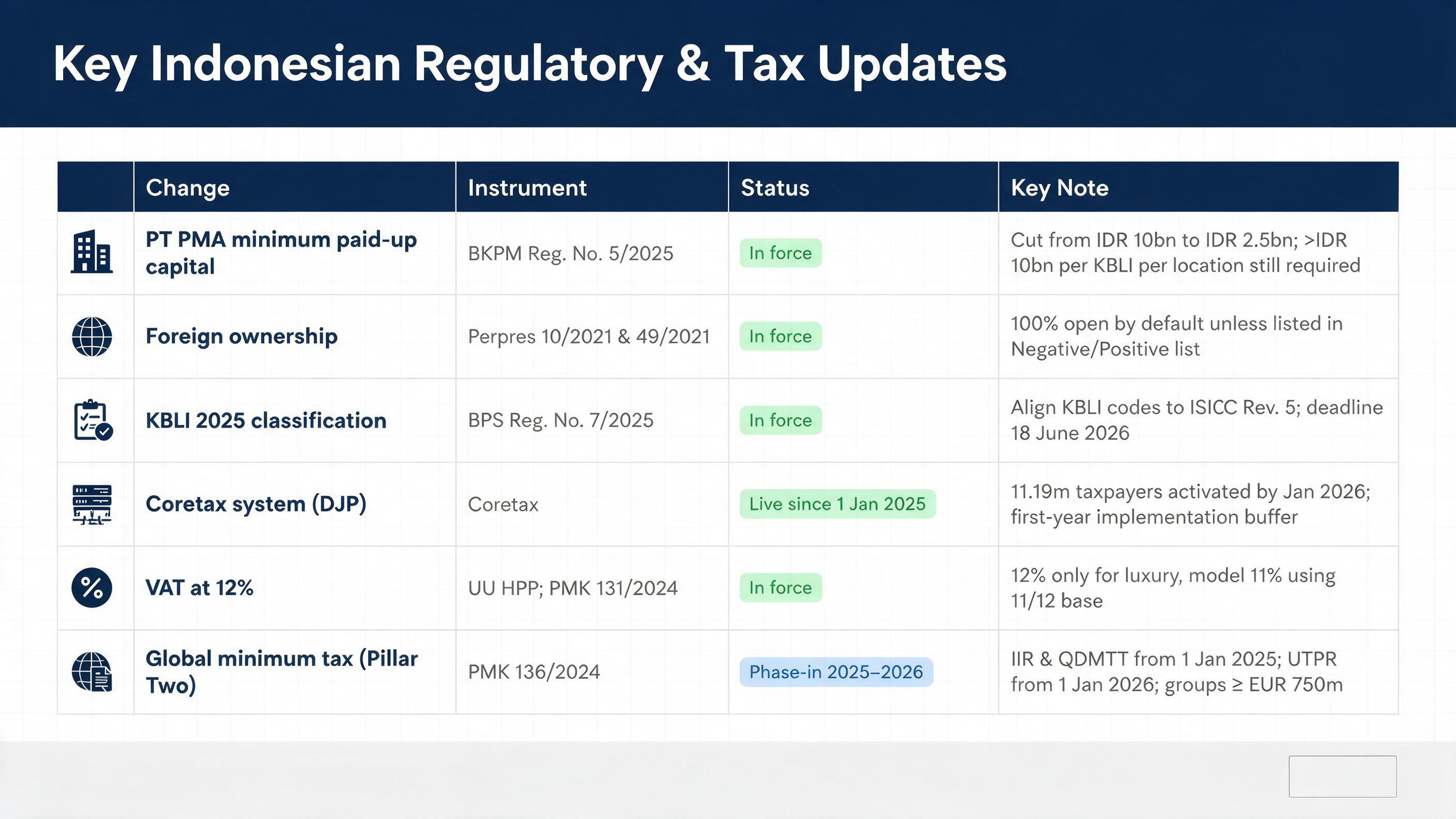
For structuring: the Indonesia–Singapore DTAA (in force since 2021) delivers 10% on qualifying dividends, 10% interest, 8–10% royalties, a 10% branch profits rate, and capital-gains protection on unlisted shares — backed by a Bilateral Investment Treaty (in force 9 March 2021) with arbitration access. Indian investors have no comparable in-force BIT and a less favourable direct treaty. This is precisely why disciplined Indian capital routes through Singapore holding structures, and why the corridor is India–Singapore–Indonesia, not a straight line.
Indonesia Due Diligence: Where Deals Actually Fail
Here is the part the market-entry brochures do not print.
The ACFE Indonesia Chapter’s fraud survey found corruption is both the most frequent and the costliest fraud typology in Indonesia — 69.9% of cases. Globally, asset misappropriation dominates. Read that again: a control framework imported unchanged from a Mumbai or Singapore parent is calibrated to the wrong primary risk.
The pattern repeats in every documented Indonesian governance failure. Garuda Indonesia booked ~USD 240 million of unearned contract income as 2018 revenue; the restatement swung a reported profit to a ~USD 175 million loss and OJK fined directors personally. Tiga Pilar Sejahtera: ~IDR 4 trillion of overstatement and IDR 1.78 trillion in suspected flows to affiliated parties. Jiwasraya: IDR 16.8 trillion in state losses. The common thread is never a bad market. It is related-party leakage, revenue-recognition manipulation, and boards that saw the numbers too late.
Layer on the general base rates — 70–90% of M&A fails to create value (HBR), and Gartner predicts more than 70% of recent ERP initiatives will miss their business case by 2027 — and the conclusion is unavoidable:
In Indonesia, the binding constraint on foreign capital is not market access. It is operating discipline.
Sector Lens: Manufacturing, FMCG, and Tech
Manufacturing / FMCG / processing. The demand thesis is intact, but three system-level items decide outcomes. First, the halal mandate (UU 33/2014; GR 42/2024): imported food, beverage, and cosmetics face a certification deadline of 17 October 2026 — months away; uncertified product gets labelled non-halal or withdrawn. Second, local content (TKDN) was overhauled by Minister of Industry Regulation 35/2025, and government procurement prioritises TKDN-compliant product — ask Apple, whose iPhone 16 was banned from sale until it committed over USD 300 million locally. Third, 2026 minimum wages: Jakarta at IDR 5.73 million/month is roughly 2.5× parts of Central Java. Plant location is a controls-and-cost decision, not a real-estate decision.
Tech / SaaS / digital. Indonesia’s data protection law (UU PDP, Law No. 27/2022) has been fully enforceable since October 2024 — GDPR-grade obligations, extraterritorial reach, fines up to 2% of annual revenue. The supervisory body mandated by Article 58 does not yet exist, which means enforcement is currently light and will not stay that way. Build compliance before the regulator arrives, not after. Add mandatory PSE registration for foreign platforms (MR 5/2020) — PayPal and Steam were blocked in 2022 for missing it. A SaaS thesis without a PDP-and-PSE workstream is incomplete.
The Pre-Wire Checklist
Before capital moves, I want evidence on five things — none of which appear in a standard financial DD scope:
Related-party map. Every affiliate, every flow, tested against the Tiga Pilar pattern.
Revenue recognition substance. Contracts to cash, not management representations.
ITGC and ERP readiness. Who can change the numbers, and who would know?
Fraud exposure calibrated to Indonesia — corruption-led, not misappropriation-led.
Regulatory position: KBLI alignment, Coretax standing, halal/TKDN/PDP status by sector.
Deals that pass this screen scale. Deals that skip it become the impairment note in your FY2028 accounts.
Final Thought
Indonesia in 2026 offers what few markets can: scale, growth, a reforming entry regime, and — for Indian capital especially — a corridor that Singapore has already proven and India has barely used.
But this market does not reward the most ambitious entrant. It rewards the most systemized one.
The thesis gets you in. The systems keep you in.