

Andrej Karpathy built LLM Council as, in his words, a fun Saturday vibe-code project, and left it on GitHub for other people’s inspiration. I took his Saturday and turned it into seven months.
If you are wondering who on earth Karpathy is: he co-founded OpenAI, the company behind ChatGPT, ran AI for Tesla’s Autopilot, and in May 2026 joined Anthropic to work on how Claude is pre-trained.
Did we ever meet? Speak on the phone? Neither. Open source lets two people collaborate for a profession without ever being introduced. One gives away an idea; the other gives away seven months.
Very few of those months went on clever prompts. Most went on one humiliating defect: my tool read a Rs 44 interest line in a GST notice as Rs 1.24 crore. Confident. Beautifully formatted. Wrong by nearly three lakh times.
The model wasn’t to blame. I was. A rule I wrote mistook the notice’s own header for an annexure, so the last demand line swallowed every figure beneath it. Since that day the tool has one founding principle: a machine may draft, but it is never trusted.
The machine is already on the other side of the table
Look at who automated first. In Jakarta, the tax office now runs supervision digital-first under PMK 111/2025, and SP2DK clarification letters land in the taxpayer’s Coretax account without waiting for any audit calendar.
In New Delhi, the GST system raises mismatches by itself. Rule 88C issues a DRC-01B when GSTR-1 and GSTR-3B liability diverge. Rule 88D issues a DRC-01C when GSTR-2B credit and the GSTR-3B claim diverge. Singapore has gone further and written the governance manual too: model frameworks for generative AI in 2024 and agentic AI this year.
So the notice comes from software. And the reply? In most small practices it’s last year’s reply to a different client, reopened in Word at ten at night, with the client name changed in eleven places and missed in the twelfth. Every partner reading this has caught the twelfth at least once.
Drafting was never the responsibility
Radiology triages scans with algorithms. Pharmaceutical research screens compounds before a single wet-lab run. Neither profession handed over the signature. They moved the machine to the volume and kept the judgment human.
Accountancy has the most rule-bound, deadline-driven workload of any profession I know, and it is among the slowest to move. Technology is not the reason. We have confused the act of drafting with the act of professional responsibility. They were always separate. The article assistant drafted; the partner signed. A model is only a faster junior who never sleeps and must never be trusted unchecked.
What the panel actually does
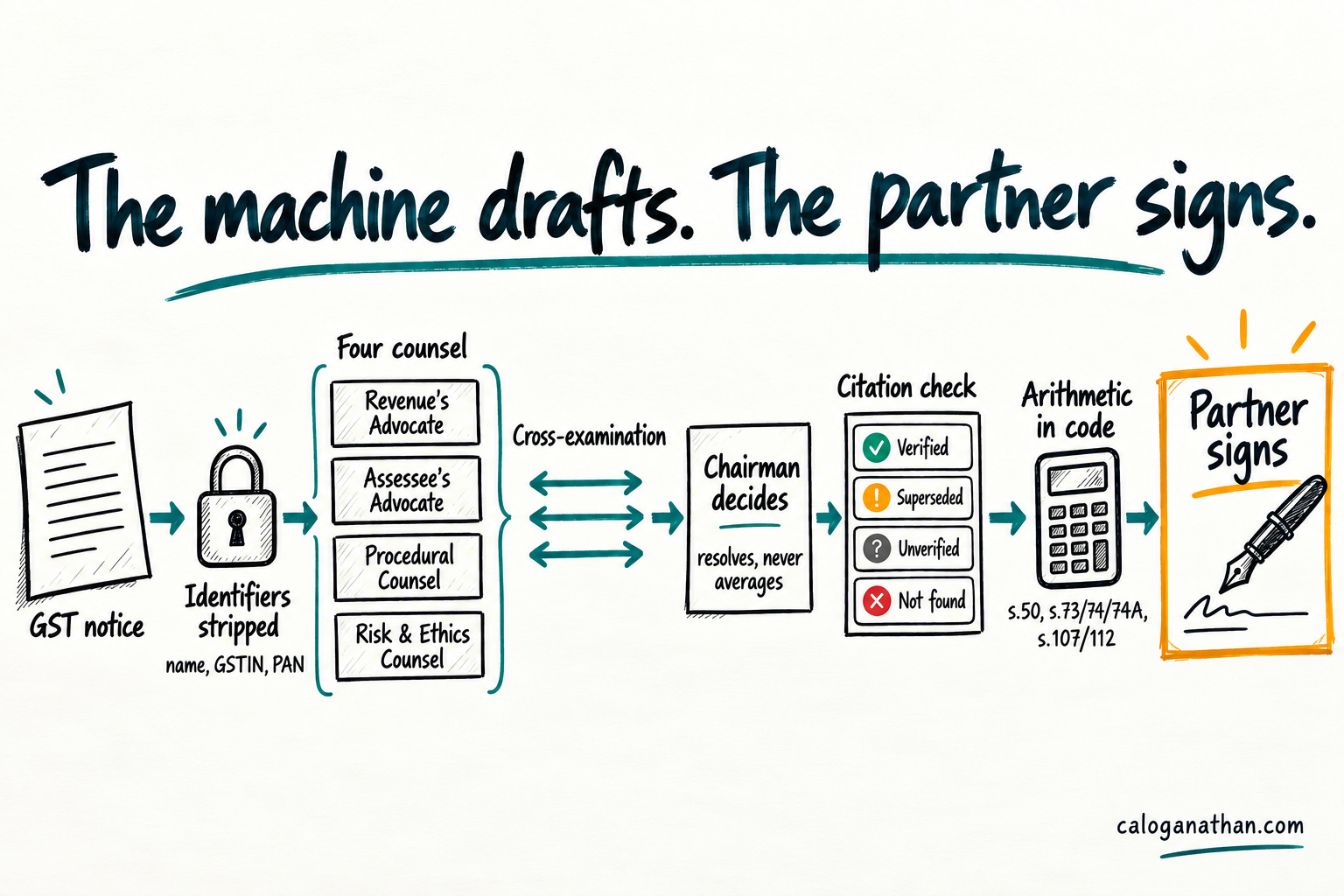
The GST India LLM Council is open-source on GitHub. You upload a notice, and four AI counsel argue it. They’re organised by their role in the argument, not by statute:
Revenue’s Advocate puts the department’s case at its strongest, so the weakness surfaces in your office and not across the officer’s table.
Assessee’s Advocate builds the merits case and grades each argument strong, defensible or weak.
Procedural Counsel takes limitation, jurisdiction, natural justice and defects in the notice itself.
Risk & Ethics Counsel weighs penalty exposure, how aggressive the position is, and cross-State consistency.
Then they cross-examine each other, flag citations they doubt, and concede where beaten. A chairman model decides last. It does not average; it settles each disagreement openly, the way a partner does after the juniors have finished shouting politely.
Four rules I would not bend
1. No citation reaches a partner unchecked. Every authority is marked Verified, Superseded, Unverified or Not Found. Nothing gets quietly upgraded. The honest limit is printed in the tool: it searches public sources. It’s a net against fabrication, not a licensed citator.
2. Statutory arithmetic is code, never a prompt. Interest under section 50, penalty stages under sections 73, 74 and 74A, pre-deposit under sections 107(6) and 112(8), limitation and section 128A eligibility are all computed in Python with the working shown. Ask a model for 18% on 402 days twice and you may get two answers. An officer will not accept either.
Here’s why it matters. Interest under section 50(3) applies only where credit was wrongly availed and utilised. Credit availed and reversed unused falls outside section 50(3) entirely. That is a ground of defence, and it gets conceded routinely because nobody asked whether the credit was ever used.
3. Client data stays home where it can. The Draft tier strips client name, GSTIN and PAN before any request leaves the machine. The run aborts if a single identifier survives. Reconciliation rows never reach a model: they’re bucketed locally into timing, RCM, import IGST, non-filer, ineligible and the rest, and only the totals travel.
Scanned notices are read by local OCR, because a page image cannot be anonymised before it’s uploaded. The Pro tier does send full facts, over zero-data-retention routing, and that is the partner’s decision under the engagement terms. The DPDP obligations on data fiduciaries arrive on 14 May 2027. The CA’s duty of confidentiality arrived long before any of us.
4. The reply date is the first screen. Miss the window and an order can follow for the full amount proposed: under section 73(9) for periods up to FY 2023-24, and under section 74A from FY 2024-25. The reply has become an appeal, with a pre-deposit and a limitation clock of its own. So the dashboard opens on overdue and due-this-week matters. Every date exports to your calendar with a reminder two days out, because the day before is too late to ask a client for documents.
If field notes like this are useful on a Wednesday, subscribe. It’s free, and it arrives once a week, not twice.
The risk was never the machine
The profession asks, “Should we let AI draft?” The better question is whether our current process verifies anything at all.
Governments have automated the side of the table that issues the notice. The side that answers is still reopening last year’s Word file at night. A reply built on a precedent nobody has reread since 2019 is already unverified; it only looks like human work. The danger in our profession was never the machine. It is unverified drafting at volume, done by hand.
The filing side is digitising everywhere. The UK moved sole traders and landlords with qualifying income over £50,000 onto Making Tax Digital for Income Tax from 6 April 2026. Jakarta went digital-first on supervision. The reply desk is where the lag sits.
None of this dilutes the member’s responsibility. Failing to exercise due diligence, or being grossly negligent, remains professional misconduct under the Chartered Accountants Act, 1949, Second Schedule, Part I, Clause (7). Every output is a draft for the engagement partner to settle and sign. Draft-tier exports carry “not for filing” on every page.
I did try blocking export altogether. People simply copied the text out, and the watermark died quietly in the clipboard.
Credit, and the licence
The idea of several models answering, refereeing each other blind and a chair settling it belongs to Andrej Karpathy. His repository carried no licence file, so rather than lean on a licence that didn’t exist, I rewrote the inherited transport, storage, prompts and schema. The compliance layer is original work, released under the Apache License 2.0.
Your firm or your developers may use it, modify it, run it internally and build on it commercially. The conditions are the ordinary Apache ones: keep the copyright notice, keep the NOTICE file, state what you changed. You pay your own model bills, and a Draft run costs cents.
The credit to Karpathy stays in the NOTICE file permanently. A rewrite changes whose lines are in the file. It does not change whose insight started it.
A plain word before you clone it. This is shared as a colleague’s work in progress, not as a product and not as professional advice. It comes as is, without warranty, exactly as the Apache licence says. No one has endorsed it: not Karpathy, not any model provider, not any regulator or professional body.
Nothing in it moves the signature. The member who files remains answerable for every word. I am not selling it, and there is no paid version. What I would value from you is criticism, a star in the repo, pull requests and technical guidance, in that order.
The Monday test
Pull your last five replies to DRC-01, ASMT-10 or DRC-01C notices. For every authority cited, try to produce the reported text today. Count the ones you can’t. That number is your real verification rate.
Take one open ITC-mismatch notice. Check that your engagement letter covers it, then run it on the Draft tier with identifiers stripped. Compare the bucketed reconciliation against the single lump sum your team argued, and mark every category you conceded that was really timing or RCM.
Ask who holds the reply-date calendar. If the answer is a person and not a system, you have key-person risk sitting directly in front of an ex-parte order.
Close
Every Indian family has one uncle who audits the wedding expenses uninvited. Give him a calculator and he will use it happily. Then he totals the column once more by hand before he puts his name to it. That is the posture I want for our profession: the machine for the volume, the uncle for the signature.
Clone it, break it, and tell me which notice it got wrong. Better still, hit reply: which notice type should it learn next, the one your office quietly dreads?
Lift as you Rise.
Good analysis and timely suggestions to over come this practice which may create legal litigation.