

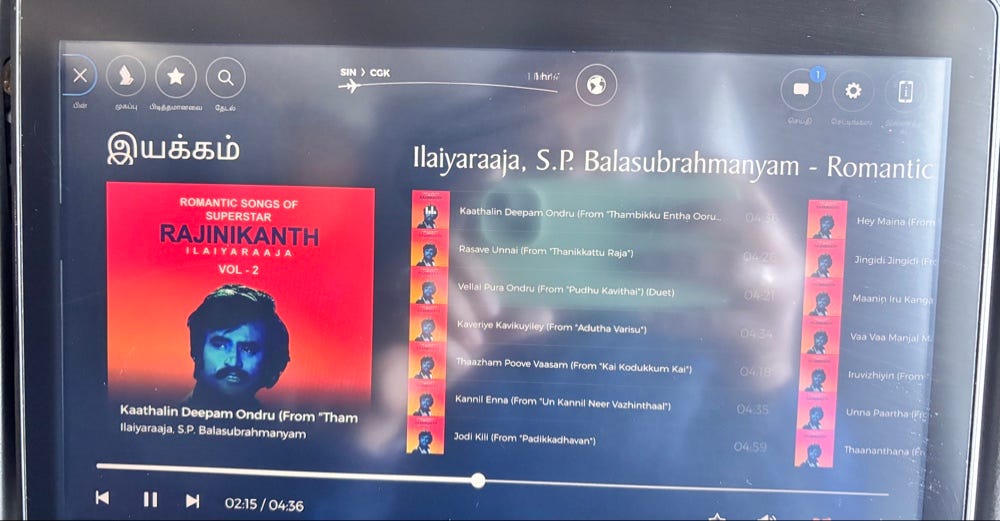
The seat-back screen said one hour, forty-six minutes to Jakarta.
I had cleared my inbox somewhere over the Riau Islands and opened the entertainment menu the way you open a fridge you already know the contents of — without expectation, mostly out of habit.
What loaded was a red album cover with a face on it I have known longer than I have known my own reflection.
Romantic Songs of Superstar Rajinikanth, Volume 2. Ilaiyaraaja.
I tapped the first track. Kaathalin Deepam Ondru. Four minutes, thirty-six seconds.
By the second bar of the interlude, I was not a President Director on a Friday evening sector. I was a boy in mid 80s, sitting too close to a television set that did not belong to my family (well same scenarios in most us in the same batch), in a room where I was tolerated rather than invited!
That is the thing nobody warns you about. You can spend twenty years building a career across three countries, learn to read a room in Bahasa and a balance sheet in three GAAPs (apart from IFRS), sit on the correct side of the correct table — and a bassline written in 1984 will find you at thirty-five thousand feet and take all of it away in eight seconds.
The anatomy of a time machine
Ilaiyaraaja does not compose songs. He composes retrieval systems. Those interludes were written before most of us had vocabulary for what we were feeling, which is precisely why they still work — they were filed somewhere older than language, in the part of memory that predates the ability to describe it. Every one of us who grew up in that decade is carrying an Ilaiyaraaja track that functions as a key to a room we cannot otherwise enter.
S.P. Balasubrahmanyam never sang at you. He sat down beside you. There is a particular quality in SPB’s delivery — a kind of unhurried companionship — that makes a love song feel less like a performance and more like a friend telling you something he has been carrying for a while. He died in September 2020. A great many of us have still not properly absorbed that.
Rajinikanth was never about acting, and anyone who argues the point has missed it entirely. Rajinism was a posture. It was permission. For a generation of boys in small towns and Tamil-medium classrooms, it was a rehearsed way of walking into rooms we had not yet earned the right to walk into. Some of us are still using it.
The fourth name
Here is what I did not know on that flight, and only worked out afterwards.
What I was playing was the male version.
Thambikku Entha Ooru (1984, directed by Rajasekhar, written by Panchu Arunachalam) carries two recordings of the same melody. SPB’s runs four minutes thirty-six. The other version — the same tune, the same aching line about a single lamp of love lit in the heart — runs four minutes thirty, and belongs to a woman.
That one is S. Janaki’s.
She died on 11 July this year, in Mysuru, at eighty-eight.
In 2013 she declined the Padma Bhushan. Her stated reason was that it had arrived too late, and that her contribution deserved better than an afterthought.
She was right (my humble personal opinion). And to my mind, the fact that this was treated as a controversy rather than as an indictment says something about how recognition gets distributed in this part of the world — abundantly to the men who front the work, grudgingly and belatedly to the women whose voices carried it.
So: Ilaiyaraaja, SPB, Rajinikanth, Janaki Amma. The four who made that music ours.
Two of them are already gone.
The songs did not notice. They kept playing on a Boeing over the Java Sea, at a volume set by a stranger, for a man who needed them and had not known it when he boarded.
Now the part where the auditor wakes up
I want to be careful here, because there is a version of this essay that would take a real moment of grief and monetise it into a LinkedIn lesson about customer experience, and that version deserves to be deleted.
But I did notice something, and it is worth saying plainly for the benefit of my fellow professionals, clients or students.
Somebody at Singapore Airlines (SQ) decided that a Tamil playlist from the 1980s belonged in the inflight library on a Singapore–Jakarta sector.
Think about how small that decision is. It is a one-hour-and-forty-six-minute hop. The commercial logic of that route is business travellers, Bahasa and Mandarin content, maybe a Bollywood shelf if you are being generous. There is no revenue line item anywhere that says 1984 Ilaiyaraaja catalogue.
Somebody put it in anyway.
That is not content strategy. Content strategy is what you do when you are averaging across a demographic. This is the opposite — it is the assumption that on any given rotation there is exactly one person in the cabin for whom this specific thing will detonate, and that finding him is worth the licensing cost.
I have spent two decades advising businesses across the India–Indonesia–Singapore corridor, and I will tell you what almost every one of them gets wrong about experience.
They think experience is what you add after the price is agreed. A better lobby. A nicer deck. Faster email replies. The garnish on a commodity.
It is not. Experience is the thing that decides whether the price conversation happens at all.
And here is the part that is specific to our corridor and that I do not think gets said enough: the people making these decisions — the CFOs, the second-generation family owners, the promoters who still sign every cheque over a certain figure — are, overwhelmingly, 70s and 80s kids. Same television sets. Same songs. Same posture borrowed from the same films.
That cohort does not buy the cheapest option. It never has. It buys the option that demonstrates it was seen.
You can measure this badly and conclude that they are irrational, or premium-brand-loyal, or slow to switch vendors. Or you can understand the actual mechanism, which is that a generation raised on scarcity assigns enormous value to being anticipated. To walking into a place and finding that someone had already thought about you before you arrived.
Every professional-services firm in this region competes on fee. Almost none competes on anticipation.
Experience is not a line item. It is the whole invoice.
What I actually took off that aircraft
I landed. Cleared immigration. Opened my MS Surface in the car on the toll road into town and answered eleven emails before the traffic cleared.
The song kept playing somewhere behind all of it, the way these things do.
This post is called From Tamil Medium to the Boardroom because that is the distance I have walked, and because I do not think the walk is as heroic as the title makes it sound. Most of it was luck, timing, and people who opened doors they had NO obligation to open.
But there is one continuous thread running the whole length of it, from that borrowed television to a seat on a Friday evening sector, and it is not a qualification or a credential or a title.
It is a set of songs.
We spend our working lives building the future — systems, controls, structures, entities, successions. Our souls get recharged on brief unscheduled visits to the past.
Janaki Amma sang for sixty years so that a stranger four decades younger could be ambushed by her colleague’s voice at cruising altitude and remember exactly who he was before he became useful.
That is a life. I am not sure any of us in advisory will manage anything close.
Go and play the female version tonight. All the way through.
Then tell me your track — the one that works as your time machine. I will listen to every single one of them on the next flight. Cheers!
Lift as you Rise.
Truly a nice writeup. Keep it up. Sinking the true feelings in words, is a priceless art. Mermerized listeners of the past will vouch for the sweet thoughts.